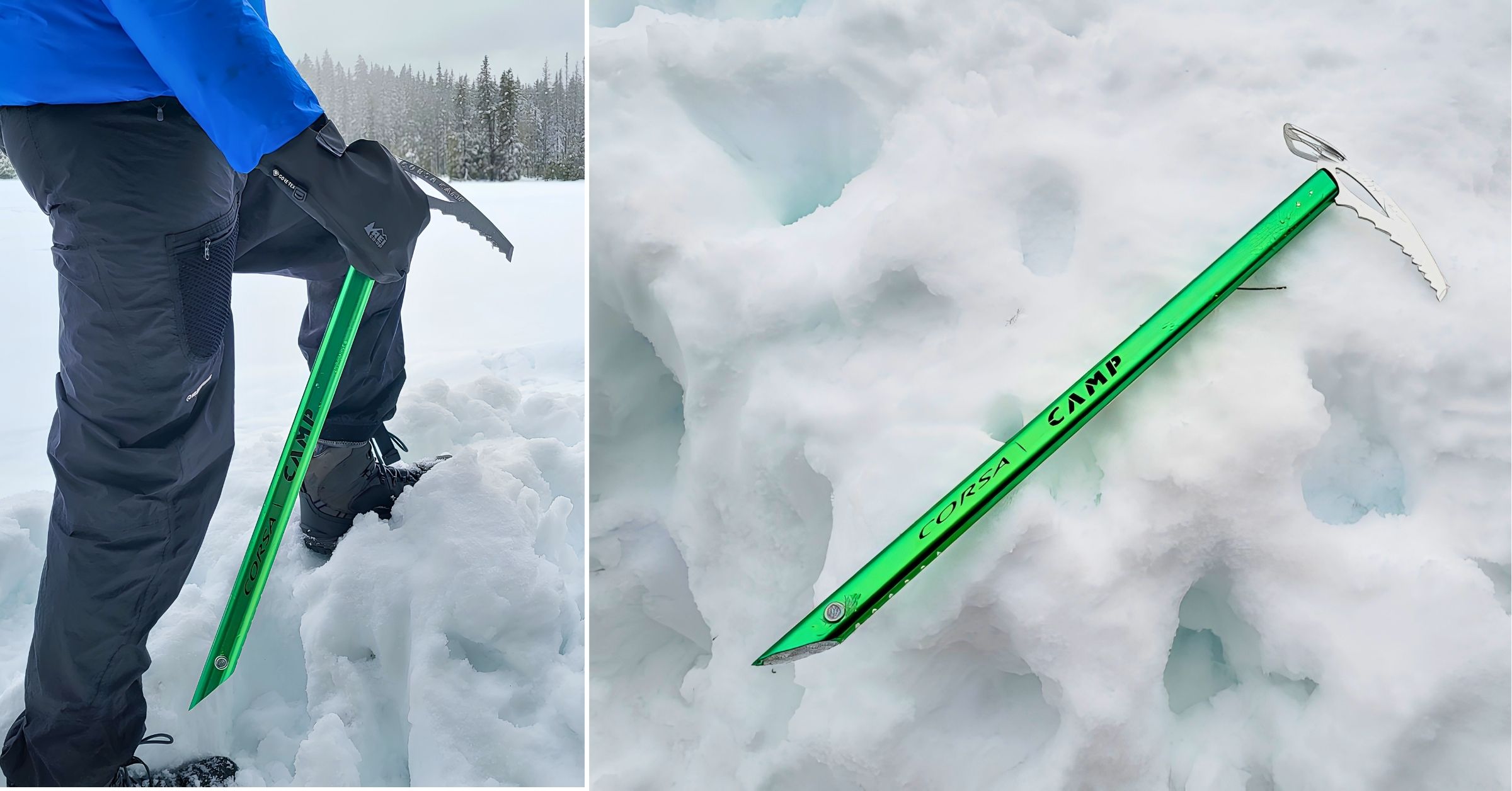
The CAMP Neve has been a staple recommendation for climbers building their first mountaineering kit for over a decade, and it still holds up. In this CAMP Neve review, we break down what the axe actually does well, where it falls short, and who should skip it in favor of something else. If you’re weighing a general mountaineering axe for glacier travel, moderate snow climbs, or a straightforward summer alpine route, this is one of the first axes worth putting on your shortlist.

The CAMP Neve is a dependable, no-frills general mountaineering axe built around a forged chromoly steel pick and adze, a straight aluminum shaft, and a B-rated certification. It’s not built for technical ice or mixed climbing, and it won’t win any weight competitions against ultralight options like the CAMP Corsa. What it does is handle glacier travel, snow slopes, and moderate mountaineering routes competently, at a price point that undercuts most of its direct competitors.
Buy it if you’re a newer mountaineer who needs one solid axe for classic routes, or an experienced climber who wants a durable backup that won’t dent your budget. Skip it if you’re chasing grams for ski mountaineering or need a T-rated shaft for technical ice.
Who the CAMP Neve Is For
This axe is built for general mountaineering, not technical climbing. That distinction matters more than most buying guides admit. If your season looks like glacier crossings, moderate snow couloirs, and standard summit routes on peaks like Rainier or the Alps’ classic snow lines, the Neve is proportioned correctly for that work.
It’s a particularly good fit for:
- Climbers buying their first ice axe who don’t want to overspend before they know how often they’ll use it
- Guided groups and mountaineering courses where durability matters more than shaving grams
- Backup or second-axe situations where you want a reliable spare without duplicating a premium tool
It’s a poor fit for anyone climbing sustained water ice, mixed terrain, or steep alpine ice where a technical, T-rated shaft and aggressive pick geometry actually matter. For that kind of terrain, you want to be looking at our breakdown of the best technical ice tools for alpine ice instead.
CAMP Neve Specs and Performance Breakdown
Head and Pick

The Neve uses a two-piece welded chromoly steel head with a curved pick designed for controlled self-arrest rather than aggressive ice penetration. The pick geometry is moderate, not the reverse-curved, technical shape you’d find on a dedicated ice tool. It bites cleanly into firm snow and moderate névé, and the curve is forgiving during self-arrest practice, which matters if you’re still building that muscle memory.
The adze has an ergonomic, slightly curved profile that handles step cutting and platform chopping without much fuss. It’s not oversized, but it’s functional for the kind of snow work general mountaineering actually demands.
One detail competitor reviews rarely mention: the Neve includes CAMP’s CC4U wear indicator on the pick, a small marking that shows when the pick has worn past a safe limit. On a budget axe, that’s a genuinely useful inclusion since chromoly pick wear isn’t always obvious to the eye.
Shaft and Spike

The shaft is a straight, 2.5mm 6082-T6 aluminum profile, certified B-rated (EN 13089 Type 1) rather than T-rated. That means it’s rated for general mountaineering use, plunging, self-arrest, and moderate anchoring, but not for the higher loads of technical protection or belaying directly off the shaft. If you need a T-rated axe for that kind of use, the Neve isn’t your tool.
The steel spike is symmetric and plunges cleanly into snow. Carabiner holes at both the head and spike let you rig a leash or clip it to your harness without extra hardware.
Weight and Lengths
Weight scales with length, which is worth knowing before you buy since a lot of listings only quote one figure:
| Length | Approximate Weight |
|---|---|
| 50cm | ~455g |
| 57cm | ~495g |
| 65cm | ~535g |
| 73cm | ~585g |
| 80cm | ~625g |
That range puts the Neve solidly in the “average” category for general mountaineering axes. It’s noticeably heavier than CAMP’s own ultralight Corsa line, but that’s an intentional tradeoff. If weight is your top priority for ski mountaineering objectives, our guide to the best lightweight ice axes for ski mountaineering covers where the Neve fits against purpose-built ultralight options.
The Neve is available in five lengths, from 50cm up to 80cm, which is a wider range than most competitors offer. That range matters for sizing: shorter lengths suit steeper, more technical use and shorter climbers, while the 73cm and 80cm options are built for taller mountaineers who want a longer cane-style axe for glacier walking.
Leash
The Neve ships with CAMP’s sliding touring leash, which adjusts along the shaft and works reasonably well for glacier travel. It’s not a premium leash system, but it’s functional out of the box and saves you an extra purchase.
Pros and Cons
Pros:
- Strong value relative to comparable general mountaineering axes
- Forged chromoly pick and adze hold up to repeated use
- CC4U wear indicator is a thoughtful, uncommon feature at this price
- Widest length range of any axe in its category, from 50cm to 80cm
- Includes a functional leash and carabiner holes at head and spike
Cons:
- Noticeably heavier than ultralight options like the CAMP Corsa
- B-rated shaft only, not suitable for technical protection or belaying
- Straight shaft and moderate pick mean it’s not built for steep or mixed terrain
- Grip comfort is average, not standout, compared to axes like the Black Diamond Raven
How the CAMP Neve Compares
CAMP Neve vs. CAMP Corsa: These two get compared constantly because they’re from the same brand but built for different jobs. The Corsa is roughly half the weight of the Neve, which makes it the better choice for ski mountaineering and fast, low-technicality objectives. The tradeoff is a less substantial head and less durability under repeated hard use. If your season is mostly glacier travel and moderate snow climbs, the Neve’s extra weight buys you more durability and a more secure self-arrest. If you’re racing the clock on ski mountaineering days, the Corsa wins.
CAMP Neve vs. Black Diamond Raven: The Raven sits at a similar price point and covers the same general mountaineering niche. In hand, the Raven tends to feel slightly more comfortable, particularly in a self-arrest grip, but the Neve holds its own on penetration into firmer snow and ice. Neither axe is going to embarrass you on a standard glacier route, so this comparison often comes down to grip feel and personal preference more than hard performance numbers.
CAMP Neve vs. Petzl Glacier: The Glacier is lighter than the Neve but comes in at a higher price. If weight matters more to you than saving money, the Glacier edges it out. If you’d rather spend less and don’t mind the extra grams, the Neve is the more sensible pick.
If you’re comparing across CAMP’s full range, our CAMP ice axes review covers how the Neve fits alongside the rest of the lineup, including the Corsa and Corsa Nanotech.
Final Verdict
The CAMP Neve earns its reputation as a dependable, budget-friendly general mountaineering axe. It’s not going to compete with technical ice tools or ultralight ski mountaineering axes, and it was never designed to. What it does, glacier travel, moderate snow climbs, and self-arrest practice, it does reliably, with a pick and adze that hold up over years of use.
If you’re buying your first axe or want a durable, no-drama tool for classic mountaineering routes, the Neve deserves a spot on your shortlist. If your climbing leans technical or weight-obsessed, look elsewhere in CAMP’s lineup or at a dedicated technical tool.
Frequently Asked Questions
Ultralight ski mountaineering axes like the CAMP Corsa Nanotech are among the lightest production axes on the market, coming in well under 200g in shorter lengths. These sacrifice head size and durability for weight savings, so they’re best suited to low-technicality objectives rather than general mountaineering use.
Yes. Grivel is one of the most established names in mountaineering hardware, and their axes are generally well regarded for build quality and performance. Models like the Grivel Air Tech Evo are respected general mountaineering axes that compete directly with tools like the Petzl Summit Evo on durability and self-arrest performance.
Start with your primary use case. General mountaineering and glacier travel call for a straight-shaft, B-rated axe like the Neve. Steeper snow or moderate ice calls for a technical axe with a curved shaft and possibly a T-rating. Length should match your height and intended use, shorter for technical terrain, longer for glacier walking. Weight matters most if you’re covering long approaches or ski mountaineering objectives.
Yes, it’s one of the more commonly recommended first axes for exactly that reason. The moderate pick curve is forgiving for learning self-arrest technique, and the durability means it can absorb the learning curve without needing to be babied.
Not for technical ice. The B-rated shaft and moderate pick geometry are built for general mountaineering and self-arrest, not sustained vertical ice or mixed terrain. For that, you’d want a dedicated technical tool with a T-rated shaft and aggressive pick.