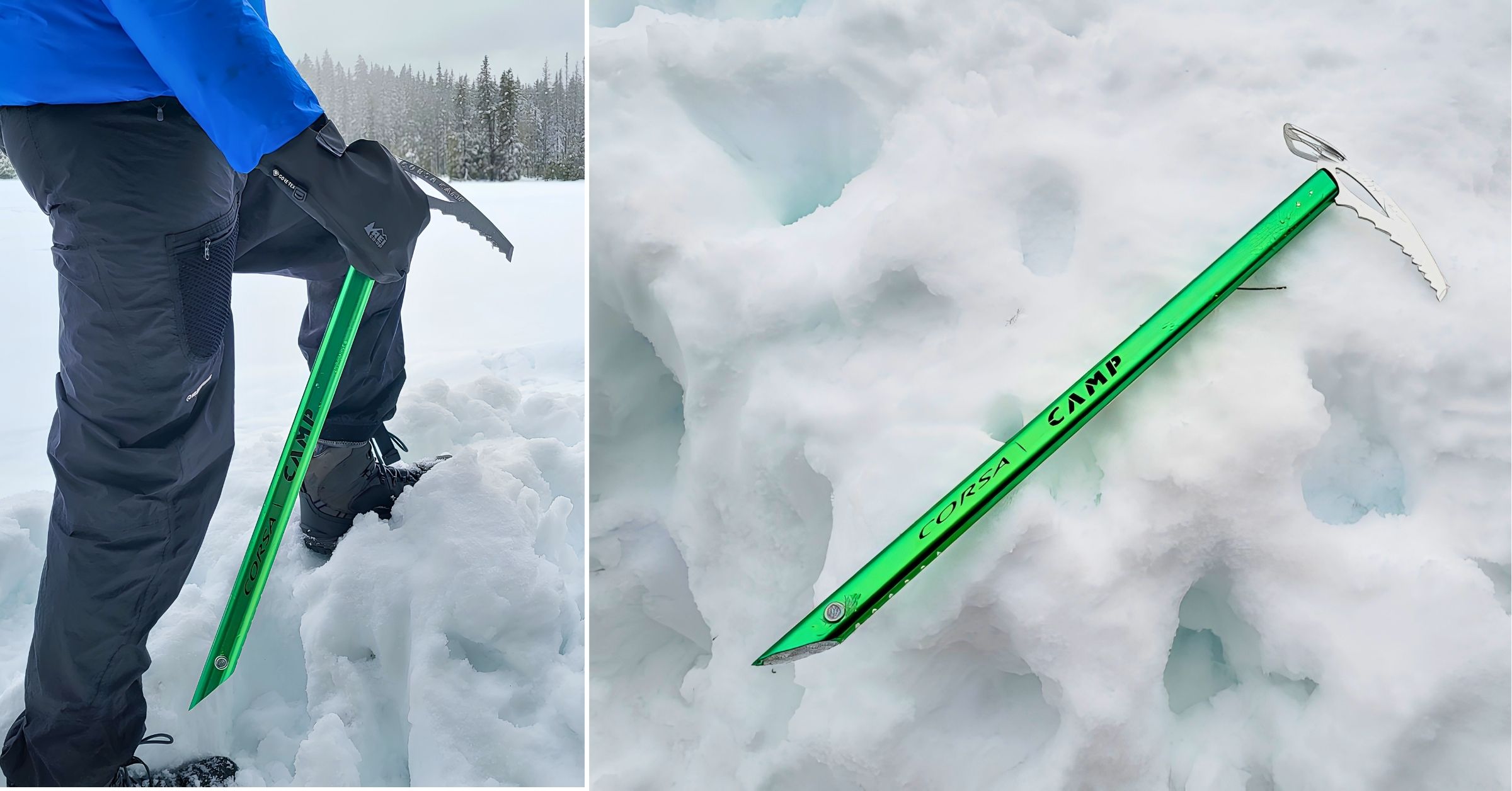
The CAMP Corsa Alpine sits in an odd spot in CAMP’s lineup: heavier than the all-aluminum Corsa, lighter than a true technical mountaineering axe, and built around a full steel head that the base Corsa doesn’t have. This CAMP Corsa Alpine review breaks down where that tradeoff actually pays off, and where it leaves you undergunned.
I’m evaluating the current generation Corsa Alpine (the black steel-head version CAMP introduced alongside the redesigned Corsa Race and updated Corsa Nanotech), tested against the same terrain criteria we use for every axe on this site: self-arrest security, plunging behavior, and how it holds up when the “easy” glacier approach turns into something steeper than expected.

The Corsa Alpine is a ski mountaineering and glacier-approach axe first, and a snow-climbing tool second. CAMP joins the featherweight Corsa aluminum shaft to an all-steel pick and adze, which buys you real bite in firm névé and hard spring snow that the pure-aluminum Corsa can’t match. It’s still a B-rated (Type 1) tool on both the pick and shaft, so treat it as a walking and self-arrest axe, not a technical one.

Buy it if you want the lightest steel-headed axe CAMP makes and your terrain tops out around moderate snow and easy alpine ice. Skip it if your season includes sustained steep snow, mixed pitches, or anything approaching WI2, where you’d be better served by a heavier hybrid like the Petzl Sum’Tec.
Check the current price and length availability of CAMP Corsa Alpine before you commit to a length, since not every retailer stocks all three.
Who the CAMP Corsa Alpine Is For
This axe is built for a specific window of use, and it’s worth being honest about that window before you spend the money.
- Ski mountaineers who want a steel pick for the occasional firm bootpack or refrozen skin track, not a full ice tool riding dead weight on their pack.
- Alpine rock climbers who need snow security on the approach or descent gully and want the axe to disappear into a pack the rest of the day.
- Glacier travelers on moderate terrain who prioritize the self-arrest reliability of a steel pick over the last few grams of savings the aluminum Corsa offers.
- Thru-hikers and long-approach hikers crossing seasonal snowfields where a lightweight axe is a “just in case” tool, not a primary piece of technical gear.
It’s not for ice climbers, mixed climbers, or anyone planning routes with sustained pitches over 45 to 50 degrees. If that’s your season, our guide to technical ice tools for alpine ice covers what you actually need instead.
Feel and Handling
The single-curve aluminum shaft is where the Corsa Alpine feels most like its cheaper sibling. In piolet-canne (cane) mode, it plants and swings naturally, and the curve gives just enough clearance from the snow surface that you’re not catching your knuckles on a low-angle plunge.
Where it separates itself from the all-aluminum Corsa is in the swing. The steel head shifts the balance forward just enough to give you feedback you can trust in firmer snow, something the aluminum-headed Corsa struggles with once conditions harden past soft spring corn. It’s still not a swinging tool in the ice-tool sense; you’re placing it more than swinging it, and that’s by design.
Self-arrest technique on the shorter 45 cm length takes some adjustment if you’re used to a traditional 60 to 70 cm mountaineering axe. The shorter shaft means less leverage rolling into arrest position, which is a known tradeoff across every ultralight axe in this weight class, not a flaw unique to CAMP.
Design and Build

The core spec that defines this axe: CAMP pairs the hyperlight Corsa aluminum shaft with a full steel head, covering both the pick and the adze. That’s the actual differentiator versus the rest of the Corsa family, and it’s worth laying out clearly since CAMP’s naming across this lineup gets confusing fast.
| Model | Weight (approx.) | Head Material | Best For |
|---|---|---|---|
| CAMP Corsa | ~200g (50cm) | Full aluminum | Lowest weight, softest snow only |
| CAMP Corsa Alpine | 240g (45cm) / 265g (55cm) / 290g (65cm) | Full steel | Firmer snow, glacier travel, ski mountaineering |
| CAMP Corsa Nanotech | ~246g (50cm) | Steel spike + pick tip, aluminum body | Middle ground between Corsa and Corsa Alpine |
| CAMP Corsa Race | ~185-190g (50cm) | Minimal, non-welded | Skimo racing, weight above all else |
Weights are manufacturer-stated figures; verify current specs against CAMP’s product page before publishing, as CAMP has revised this lineup more than once.
A few build details worth flagging:
- Pick: Tapered to 3mm for better penetration in hard snow and refrozen névé, a spec borrowed from CAMP’s more technical tools.
- Shaft rating: B / Type 1 on both pick and shaft (CEN-B, UIAA Type 1). This is not a T-rated shaft, so don’t use it for belay anchors or load-bearing applications the way you might a T-rated tool.
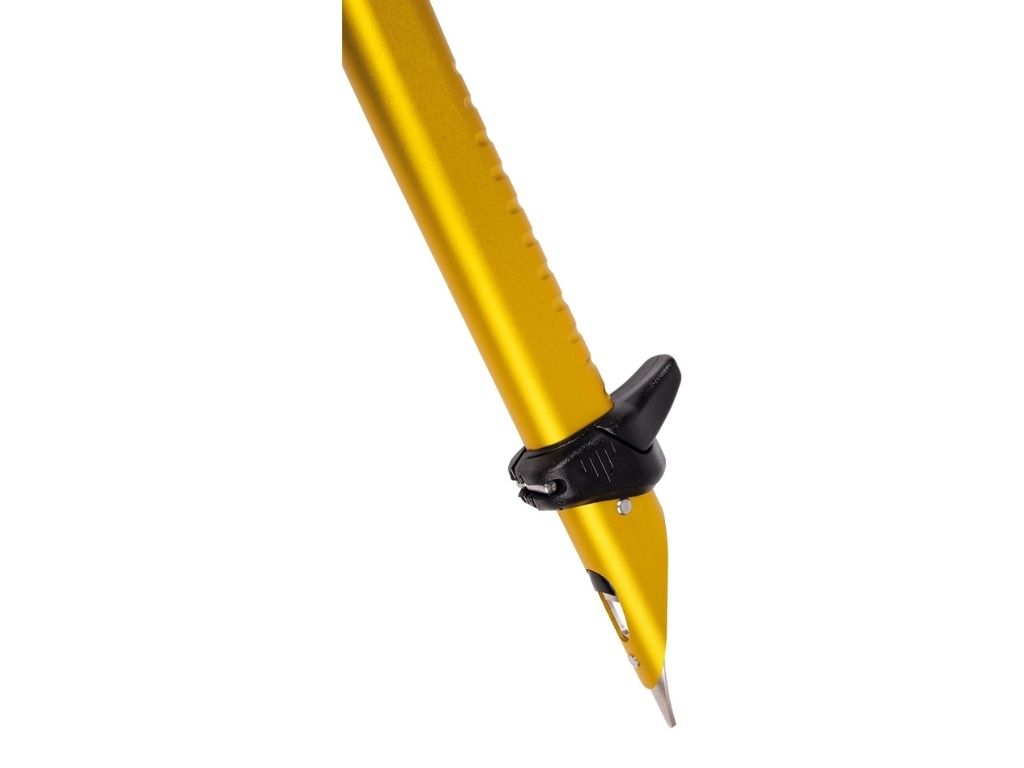
- Spike: A nylon spike plug rather than a separate steel spike, which keeps weight down but means the tip itself isn’t steel the way it is on the Corsa Nanotech.
- Grip: Machined aluminum grip with grooves rather than a rubberized overmold. Effective with bare hands, less forgiving in serious cold with gloves.
- Lengths: 45 cm, 55 cm, and 65 cm. There’s no 50 cm or 60 cm option here, which matters if you’re used to sizing off the more common length increments other brands use.
- Accessories: The Trigger Fast Lock pinky rest and the Corsa Leash are sold separately and worth adding if you plan to use this as anything more than a backup tool.
If you’re trying to size this against other lightweight axes on the market, our roundup of the best lightweight ice axes for ski mountaineering has the broader field for context.
Strengths
- Genuinely light for a steel-headed axe. At 240g for the 45 cm length, it undercuts most steel-pick competitors by a wide margin.
- The steel pick gives real confidence in firm spring snow and refrozen névé where the all-aluminum Corsa starts to skate rather than bite.
- Three length options cover most ski mountaineering and alpine approach use cases without forcing you into a single compromise length.
- Machined grip and nylon spike plug are small details that show CAMP thought through weight savings rather than just chopping material.
- Reasonably priced relative to other steel-head technical mountaineering axes in this category.
Limitations
- Still a B-rated tool. If your objectives call for a T-rated shaft for belaying or anchor use, this axe is not built for that.
- The adze is functional but undersized for serious platform chopping. Don’t count on it for cutting a bivy platform in firm snow.
- No modularity. Unlike CAMP’s own lineup logic with interchangeable-pick tools, or Petzl’s ALPEN ADAPT system on the Quark, the Corsa Alpine’s pick is fixed.
- Self-arrest leverage on the shorter lengths requires more deliberate technique than a full-length mountaineering axe.
- Grip has no rubber overmold, so cold-weather comfort with thin gloves is average at best.
Comparison Context
Corsa Alpine vs. Petzl Ride: These two get compared constantly because they land in a similar weight class with a similar formula, a steel head on an aluminum shaft. The Ride’s head tapers narrower and its adze is wider, and Petzl gives the shaft a more pronounced curve. If you want a slightly more aggressive pick geometry for occasional harder ice, the Ride edges it out; if you want the lighter, simpler tool, the Corsa Alpine wins.
Corsa Alpine vs. Corsa Nanotech: The Nanotech splits the difference between the base Corsa and the Corsa Alpine, with a steel spike and steel pick tip but an otherwise aluminum head. It’s a reasonable middle ground if you want more durability than the base Corsa without the full weight of the Alpine’s all-steel head, though the practical performance gap between the Nanotech and Alpine is smaller than the spec sheet suggests.
Corsa Alpine vs. a full technical mountaineering axe: If you’re regularly hitting terrain where a Petzl Sum’Tec or similar hybrid tool would be the better call, the Corsa Alpine will feel underpowered fast. It’s not trying to compete in that category, and treating it like it can will leave you undergunned on anything approaching low-grade ice. For a full breakdown of that category, see our technical ice tools guide.
For a wider look at how CAMP’s own axe lineup stacks up beyond the Corsa family, check our CAMP ice axes review, and if you’re weighing an entirely different brand’s ultralight option, our Trango ice axe reviews cover a lower-cost alternative worth cross-shopping.
Final Recommendation
The CAMP Corsa Alpine does exactly what it’s built to do: give ski mountaineers and glacier travelers a steel pick without the weight penalty of a true technical axe. It’s not trying to be a Sum’Tec or a Quark, and judged against that standard it would fail. Judged as a lightweight, dependable snow and self-arrest tool for moderate terrain, it earns its spot.
If your season is mostly approaches, glacier crossings, and moderate spring couloirs, buy it. If you’re regularly stepping onto anything steeper or icier, spend the extra weight budget on a hybrid tool instead, and save the Corsa Alpine for the trips where you genuinely just need insurance, not a climbing tool.
Get the current price and length options for the CAMP Corsa Alpine here.
Frequently Asked Questions
The 45 cm version weighs approximately 240 grams, the 55 cm version approximately 265 grams, and the 65 cm version approximately 290 grams, per CAMP’s stated figures. Confirm current numbers against CAMP’s product page, since the Corsa line has been updated more than once.
The Corsa Alpine has a full steel head, covering both pick and adze. The Corsa Nanotech uses a steel spike and steel pick tip with an otherwise aluminum head and body, putting it between the base Corsa and the Corsa Alpine on both weight and durability.
No. It’s a B-rated (Type 1) axe designed for general mountaineering, glacier travel, and moderate snow, not sustained ice climbing. For WI2 and above, look at a dedicated technical mountaineering axe or ice tool instead.
They’re close in weight and concept, both pairing a steel head with an aluminum shaft. The Ride has a narrower pick taper and a wider adze, with more shaft curve, while the Corsa Alpine keeps a simpler single-curve profile. Choice mostly comes down to whether you prioritize the Ride’s slightly more technical pick geometry or the Corsa Alpine’s lower weight and price.
CAMP offers 45, 55, and 65 cm lengths. Shorter climbers or those prioritizing steep snow and ski mountaineering typically size down toward 45 cm, while taller climbers or those doing more glacier walking benefit from the added reach of 55 or 65 cm.